Dear Friends and Family
In search of wild gazanias Floyd and I just spent five days in an area of South Africa called Namaqualand. Namaqualand can be found in the far northwest corner of South Africa bordering Namibia. It is the largest high mountainous desert in the world and each year in the spring 1400 varieties of flowers bloom. Because of the heavy rains here this year, the flowers started blooming in August and we were privileged to enjoy this wonderful spectacle.
We traveled the N7, north from Cape Town towards Namibia, and the farther north we went the more flowers we saw; purples, whites, yellows blended together. Then the colors changed. Our first day in the region we went into Namaqua National Park to an area called Skilpad, pronounced “skeel-pod”. Billions of orange flowers greeted us and tucked among them were termite mounds and other flowers of every hue.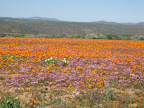
This picture illustrates how the sheer mass of color changes across the landscape.
In the Namaqualand area there are three flowers zones. The flowers by the coast are different from those in the interior. Unfortunately the only way to see the ones by the coast is by 4X4 which we did not have, so next time.
The ones in the second zone include vygies and succulents. We were able to pay 20 rand to a local farmer and walk his field on what he called a succulent trail. There was an even more splendid array by the side of the road and in the local succulent nursery.
The third zone includes Skilpad and our favorite flower finding area, Goegap, which when pronounced starts with an H and then sounds like you are going to spit; the sound hop comes at the end. You have to think in German to get this one.
In the Goegap nature reserve, the flowers are magnificent. Purples, pinks, yellows, reds and oranges predominate. It is mountainous and craggy, with huge rocks perched on the hillsides and enormous valleys. The road into the mountain was sand based and much easier to drive than many of the other rocky dirt roads in the area.
We spent a great deal of time trying to get a “good” picture of a quiver tree, and this is a favorite.
When I look at these pictures now, it is interesting to note the light and dark differences. Part of that is due to the differences between Floyd’s and my cameras; the other because we went to Goegap on two days. One was brightly sunny without a cloud in the sky; the other rainy and cloudy. Nevertheless, the land was really beautiful both times.
But everything must end, including this note, so, as the sun sets on Geogap, bye for now.
Oh, I should tell you, we did find wild gazanias and they were beautiful.
We will be back in the States soon. Until we see you, love to all.
Betsy
Sunday, August 24, 2008
In Search of Wild Gazanias - Success


Thursday, August 14, 2008
In Search of Wild Gazanias
Dear Friends and Family
“In search of the Wild Gazania” has been the conceptual title we used for this entire trip, though as yet we have done little searching for wildflowers and are running out
of time.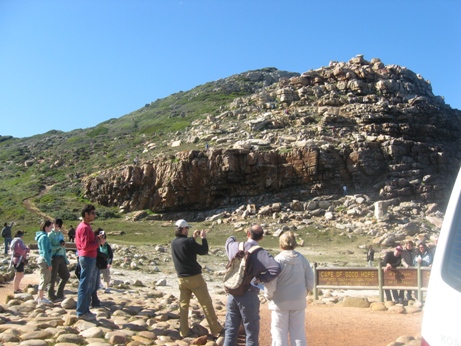
Last week we went to Cape Point National Park, because we were told that the wildflowers start in the South and then move up the coast north until the entire Namaqualand region is blanketed in wildflowers. Of course, seeing them depends on luck, the amount of rainfall the different areas have had during the winter, warmth,
and being in the right place at the right time. By the way, at Marshal’s shop in Lisle during the summer, there are South African gazanias. They are a great, short, bright daisy like flower that opens and shuts with the sun, often yellow or orange but they come in other colors. In the States they are an annual; here a perennial.
On Cape Point we saw Protea, and some other flowers we were not familiar with that reminded me of large mounds of flowering white moss; no gazanias. What we did find at the Cape of Good Hope were tourists (a rarity right now), ostrich, baboons, and other flowers in purple, pink, and white.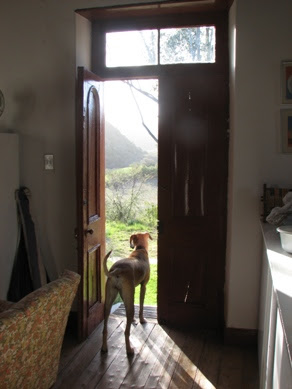
Then this last weekend we got to spend some quality time with Becky and Kurt. We took the dogs with us into the Klein Karoo (Little Karoo), a desert region, mountainous with valleys along rivers dry in the summer and wet in the winter, headed for Calitzdorp. The area is famous for its ostrich farms, lamb, port (like in wine) and succulents. We stayed several nights back in the Matijies Valley, 17 km down a steep, mountainous, dirt road. But what a special place it was. Cold, crisp, silent nights; beautiful stars, great wood fires for braiing (grilling), ostrich watching our every move, cows, sheep bleating on the mountain sides and a canyon that echoed every time a dog barked. And the dogs had such fun barking and listening for the echo; I don’t think they ever figured out that they were barking at themselves.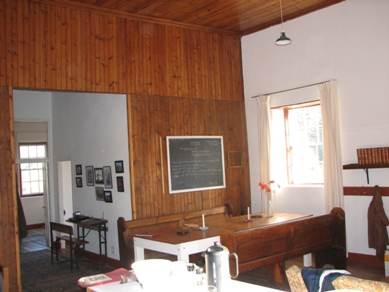
We stayed in a converted one room school house appropriately entitled the “Old School House” that was in use around 1910-1920. There was no fireplace, but somehow that old place with creaky floorboards and high, high ceilings retained the heat. Of course we packed in food. We had found a truly special place.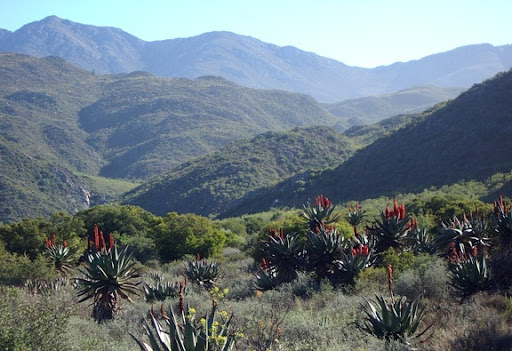
Traveling into and out of that valley was difficult but the scenery was spectacular. Large aloes bloomed on the sides of the mountains. There were birds everywhere eating the blooms. Spring was coming to the Klein Karoo.
In the valley the air was crisp and clear. Early mornings were especially beautiful and the dogs loved their morning walk.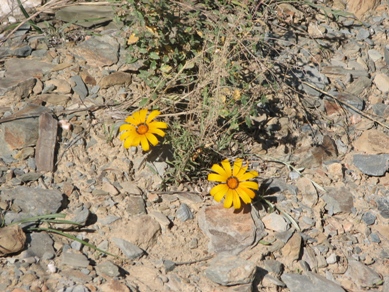
One morning there at our feet was something unexpected. A wild gazania had opened in the crisp early morning sunshine. It wasn’t a hillside full, but it was the first blooming one we had seen and it was a welcome sight.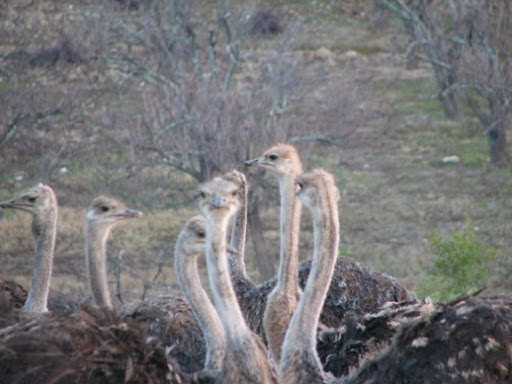
And our neighbors were really curious about what we (and the dogs) were up to. We thought about ostrich steaks and ostrich omelets, but decided to remain good neighbors.
Love to all,
Betsy (and Floyd)